Photo Tours
&
Tips on Travel Photography

Tokyo's 5 Best Photo Locations
Tokyo is one of my favourite cities and I lived there for many years. While the crazy volume of traffic and crowds can be overwhelming at times, it's always an inspiring and surprising place to explore with a camera.
Tokyo is one of my favorite cities and I lived there for many years. While the crazy volume of traffic and crowds can be overwhelming at times, it's always an inspiring and surprising place to explore with a camera. So, where should you go if you only have a few days or less to shoot this incredible city? Here are a few of my favorite locations to visit with a camera, and the stories of some of the photos I have taken there.

Being a cityscape and street portrait photographer I am always looking for ways to best combine these two genres of travel photography. It goes without saying that Tsukiji fish market is also on the list but I have not included here. However, you can read about it in my previous article. I would suggest a minimum of three days to explore Tokyo.
1. Akihabara and Harajuku
In Akihabara (aka Akiba) is where you will find electronic shops, gamers, maid cafes, manga, and anime collectors. Stroll in just before sunset. Ask a few cosplay dressers for a quick street portrait or drop into a cafe to be entertained by the cartoon grins of a waitress dressed in a French maid outfit. At dusk set up your tripod on a busy intersection to mix street car light movements and neon-lit buildings. The area is riddled with photo opportunities that should keep you busy all night. In Harajuku it is best to visit on a Sunday afternoon. You will start to see many groups congregating around the train stations nearby. Simply walk up to them and ask permission for a portrait. Offer to email them a copy if they'd like.
2. Shibuya and Shinjuku
Shibuya Crossing is a bustling intersection in the center of Tokyo where seas of people cross from multiple directions every time the traffic lights turn red. Go at dusk and take your tripod or monopod to capture the movement of the crowds while keeping the streets, buildings, and neon lights in sharp focus. There are plenty of opportunities for street portraits of young and trendy couples in the surrounding streets; Look for well-lit areas and nice backgrounds. A shallow depth of field (f/2.8) with a 50mm lens will help to throw the background out of focus and create some consistency in your portraits. Alternatively, a wide-angle lens (16-24mm) will also work if you wish to capture the surrounding buildings. Walk across the infamous Shibuya crossing with your tripod or monopod and set it down in the middle of the road while crossing. Set your shutter speed to around 1-3 seconds and click. You only have about 30 seconds to cross so you only have one to two shots per crossing. Repeat the process at different angles to get different backgrounds.

Shibuya Crossing has to be Tokyo's busiest intersection.
Shinjuku, near Studio Alta at East Shinjuku train station exit, is a good spot to float around looking for shots of neon-lit streets and funky revelers. A tripod for the streetscapes will help you get tack-sharp shots at slower shutter speeds, down around 5–10 seconds, with car tail lights creating streaks in the image to add a dynamic feel to your pictures. Try and focus on back lights (red) more than front lights (white). Wait for large traffic flows and pick a corner that has curves to add a more dynamic look. There is a lane way near the station known as piss lane. Here you might find some great street portraits with permission. Be careful when photographing without permission as too many tourists have been invading this popular spot in the last few years. Having someone who speaks fluent Japanese with you will break the ice and you'll still manage some spontaneous portraits.
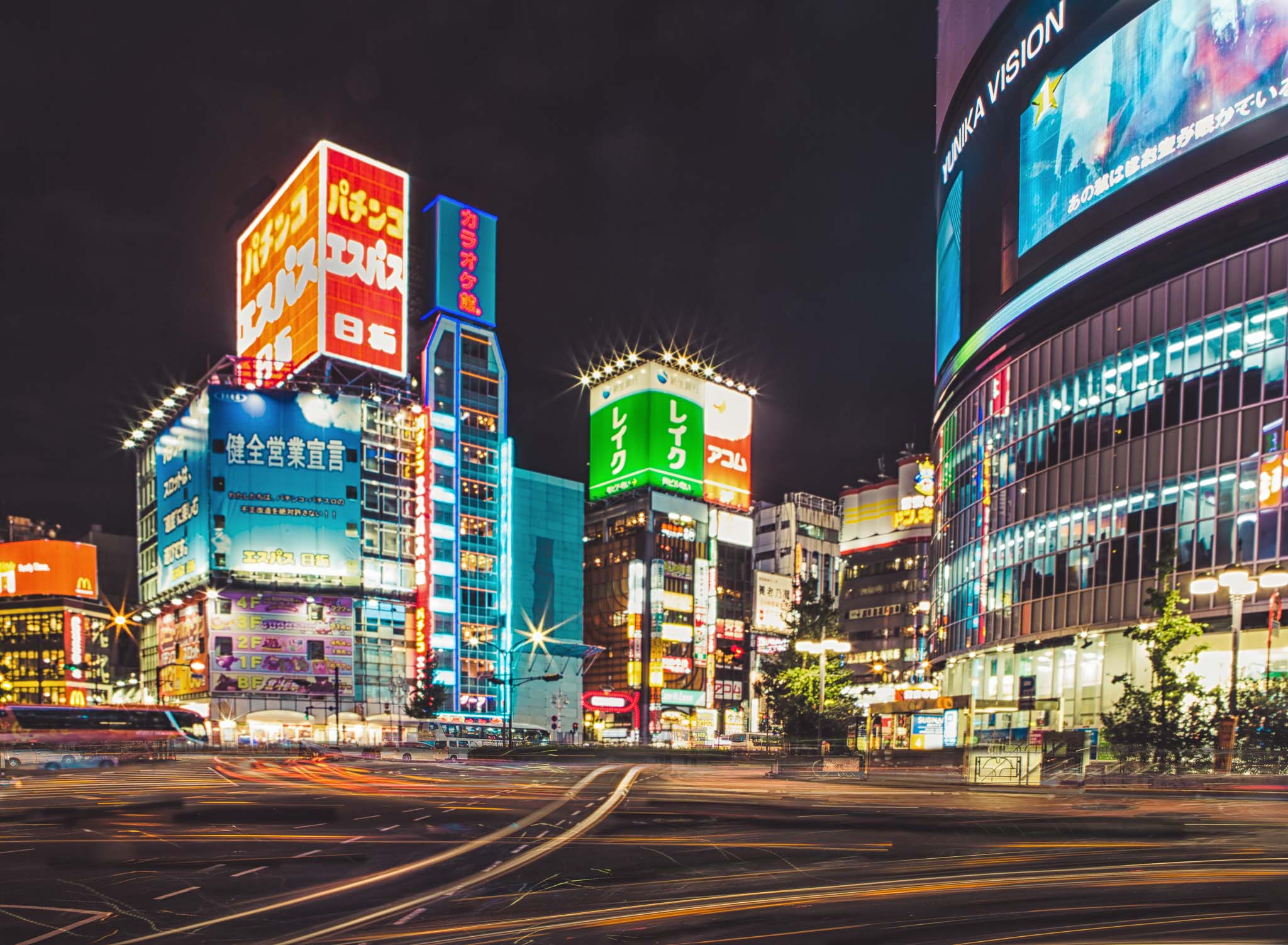
Near East Shinjuku subway exit.
3. Ueno
I used to live in the old downtown area of Tokyo, which is also known as Shitamachi, so there's a little bit of bias in this choice. This is also where my wife is from so I've spent plenty of time exploring the back streets and alleys with my camera. Nighttime in these areas is best explored on a weekday. Anywhere along a railway track close to a station you will find hole-in-the wall style bars and street stalls. Local businessmen flock to these cheap eateries for beer and light snacks.
Streetscapes are usually best shot from walkways looking down on traffic. Use your tripod and shoot with a slow shutter speed around 10–30 seconds to get some interesting trails of car lights. Neon lights also make for lovely backdrops. The high viewpoint will help to isolate and frame your shot better. Consider a black and white conversion.

Buddhist Monk in Ueno, Tokyo.
4. Ginza
The Ginza is another great spot for street portraits and modern architecture. Visit at the end of the day when the sun is low and the contrast between dark and light adds some drama to the scene. If you're looking for amazing modern buildings to use as backdrops or subjects of your photos, the following Ginza stores are worth typing into Google Maps: Hermes, Bulgari, Mikimoto, Dior, Gucci, Louis Vitton, Prada, Ferragamo, and Zara. Best of all, most are within a three or four-block radius of the Ginza Station.

Ginza's Wako Department Store is one of Tokyo's oldest.
5. Asakusa (Traditional Temple)
Asakusa is a district of Tokyo famous for the historic Sensō-ji Buddhist temple. The Kaminarimon Gate entrance to Asakusa Temple is usually crowded, but you can avoid the rush by visiting at night when the souvenir shops have closed and the tourists have gone home. If you do want to visit during the day, the best times to travel on the subway — and avoid being shoved onto a train carriage like a human sardine — are between 10 a.m. and 3 p.m. Another mini version of Asakusa is a place 45 minutes away by train called Shibamata also worth a look if you like this kind of ambience.

Asakusa at dusk.
Of course there are many more areas in Tokyo you can explore so I would recommend a look at the very comprehensive site of Japan Guide for more valuable and up-to-date information. Traveling around Tokyo to get the best shots will have a lot to do with the best time and day of the week.
Alfonso Calero – Travel Photographer from Sydney specialising in portraits and landscapes. Regular traveller with my small photo workshops/tours in Australia , Japan, The Philippines and Spain.

Kyoto's 5 Best Photo Locations by Alfonso Calero
For first time travelers to Kyoto, it can be a bit confusing to choose where to shoot. Unlike my previous posts on Madrid and Barcelona which are about three-hour photo walks, this article will be similar to my Tokyo article which involves five different locations.
For first time travelers to Kyoto, it can be a bit confusing to choose where to shoot. Unlike my previous posts on Madrid and Barcelona which are about three-hour photo walks, this article will be similar to my Tokyo article which involves five different locations.
Here is a link to a great website to give you a better overview of each location and other locations worth a look. For those of you who have been to Kyoto, I would expect you to share your photos or suggest other locations.

Kyoto is best tackled by train or bus. Buses are cheaper with day passes available but if you happen to be there during a national holiday there will be a lot of traffic. With my private photography tours, I often try to visit during weekdays and also try to avoid the crowds where possible. Below are some suggestions on when to visit and what sort of gear to take to each location.
Tripods are hard to use in most public locations as there are crowds and you become a nuisance when setting up. Most private entry locations such as gardens and temples prohibit the use of tripods. Shooting handheld for most of the trip is the fastest way to get around.
If there are at least four in your group a taxi is the quickest way to get around. I only took a Canon 50mm f/1.2 and a Zeiss 18mm f/3.5 shooting with a Canon 5D Mark III. The five areas divided are Central, North, South, East, and West. Within each area are a few suggestions.

Google Map route Kyoto
The above map route only takes an hour if you wish to explore the philosopher's path during spring followed by the silver temple (Ginkakuji), Aqueduct (behind Nanzenji Temple), and finish off with a late afternoon to early evening stroll through Gion and Pontocho.
Central Kyoto
Kyoto Station
Kyoto station is massive when you exit the main entrance it feels like being in a cocoon. A hyper-lapse or time-lapse up and down the escalators is a fun way to get a feel for the vastness of this station. The escalators seem to go up forever to about five-floor levels. The exterior of the station looks like a cruise ship. Late afternoon or early morning light looks cool in black and white.
Kyoto Station is massive and filled with many architectural photography opportunities.

Nishiki Market
Nishiki Market is one ground level of about 1 kilometer of food stalls. It's narrow and difficult to shoot in especially since everyone seems to be stopping to eat or take a photo. White balance can be tricky in some parts. The ambiance is electric and the diversity of food from all over Japan makes it worth a short look just before lunch.

Nishiki Food Market
Pontocho
Lantern alley is my nickname for Pontocho. Once again, its narrow and crowded so be prepared to go shoulder to shoulder down two lanes at most. The area is riddled with restaurants and bars mostly catering for revelers and tourists.
Shooting handheld at around 800–1,600 ISO at 1/60s on 50mm worked a treat on f/2.8. I would suggest coming here for dinner after walking through Gion area which is only across the river.

Pontocho
North
Kinkakuji
Kinkakuji, or the Golden Temple as it is known, like all other venues, requires a small entrance fee of about 400 yen. Traffic flow of people is controlled in one direction. The Golden Temple itself can't be entered but many vantage points around the pond and garden path will make for great shots.

Kinkakuji Golden Temple
South
Fushimi Inari
Just like the bamboo grove, Fushimi Inari is always open to public access. I would suggest you get here at about 7 a.m. If using a tripod make sure not to be in the way of other visitors. Japanese are too polite to say something and there are currently no restrictions here. However, I would suggest you shoot fast and move on as the crowds start to build up from around 7:30 a.m. Weekdays in most locations in winter or summer are easier to move about. This location has been voted by trip advisor as the most popular tourist destination in Japan. The torii gates along the entire trail are donations by individuals and companies, and you will find the donator's name and the date of the donation inscribed on the back of each gate. The cost starts around 400,000 yen for a small sized gate and increases to over one million yen for a large gate.

Fushimi Inari
East
Gion
Trying to find a Geisha in Kyoto is becoming increasingly difficult. Geiko (Senior) or Maiko (Junior) as they are known in Kyoto are well aware of their popularity. They are treated like movie stars and us the tourists are the Paparazzi.

Geiko after dance class
Ginkakuji
In my opinion, I think the silver (Ginkakuji) temple is more picturesque than the golden (Kinkakuji) temple which has more Wabi - Sabi best described as a perfect imperfection. The mix of rock, sand, bridges, ponds, and perfectly positioned trees lends itself to a place where are artists can reflect on the finer aspects of Zen Buddhism.

Ginkakuji (Silver) Temple
West
Tenryuji
Tenryuji is a picturesque garden and temple with the focus more on the gardens especially in spring (cherry blossoms) or autumn (cypress trees). The gardens have a back entrance which is directly on the bamboo grove path which makes it very convenient to enter at 8:30 a.m.

Tenryuji Temple and Garden
Bamboo Grove
Getting here at around 7:30 a.m. is important to avoid the crowds. The bamboo grove pathway runs for only about 500 meters in key spots with curves or straight lines. Cars are allowed to drive through here so tripods might be in their way. Wedding shoots are done here on a regular basis and large tour groups also walk these paths.

Bamboo Grove in Arashiyama