
Photo Tours
&
Tips on Travel Photography

A Photographic Guide to Hokkaido in Winter
I've recently returned from Hokkaido, Japan, where I spent a week doing research for my 2019 photo tour. The exploration took me to Biei for snowscapes and Tsurui-mura for wildlife.
A Photographic Guide to Hokkaido in Winter
I've recently returned from Hokkaido, Japan, where I spent a week doing research for my 2019 photo tour. The exploration took me to Biei for snowscapes and Tsurui-mura for wildlife.
Flying into Asahikawa from Haneda (Tokyo), it was easy to get to Biei and settle for the next 3 nights.

Sea Eagles

Red Crowned Crane Birds
Biei
Biei is a town located in Kamikawa Subprefecture, in the centre of Hokkaido. In winter it is known for its minimalist snowscapes, however most of these are on farms and most farms are private, making them difficult to access.
I found my 100-400mm lens was perfect for shooting over fences and into the fields, and this worked perfectly to get most of the shots I needed. In fact almost all my snowscapes and wildlife shots were done with this lens.

Red Crowned Crane Birds
The winter light can be soft and luminous on the best of days, but be patient when it's looking flat and dark. The light and dark tones that reveal folds in the snowscapes are key to a successful image.
When shooting subjects like this, the challenge is to find at least three points or areas on the landscape, then use them to create a harmonious balance in your frame.
Try a great leading line and a dominant focal point to rest your eyes for detail and interest.

Biei Snowscapes

Shika Deer
The subtle red fox tracks were a small detail in some shots that really added to the ambience. Atmosphere was also brought about more easily with a little wind to kick up the powder snow.
Diamond dust with the morning light was a very special capture if the conditions were perfect.

Fox Footprints
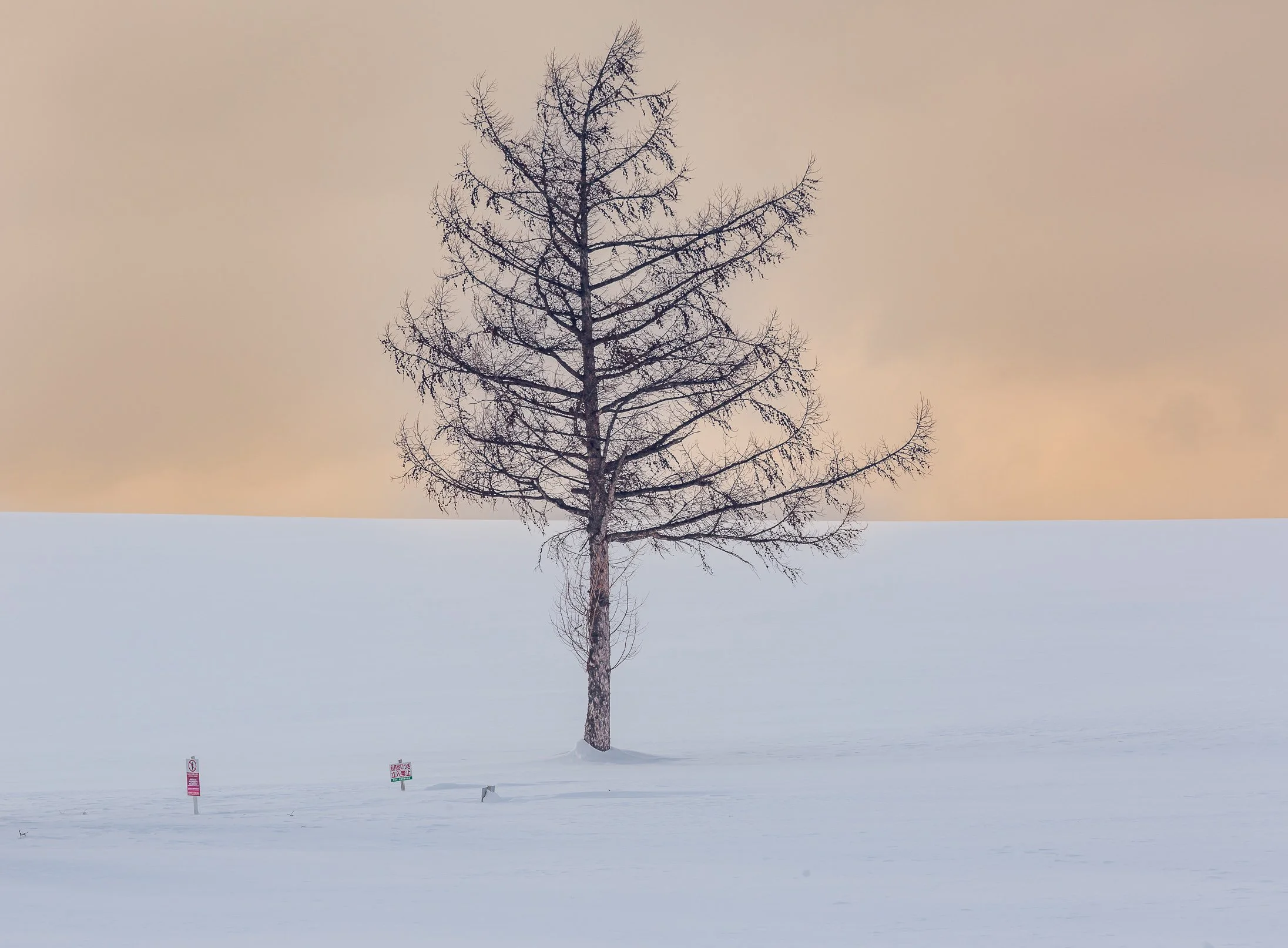
Biei Snowscapes
The white silence and purity of a clean landscape converts very nicely into black and white.
Tsurui-mura, Lake Kusharo and Rausu
For the second half of the trip I ventured to the South and North east parts of Hokkaido to visit three key areas: Tsurui-mura, Lake Kusharo and Rausu.

Ural Owls
Tsurui-mura was my base for photographing red crowned Cranes and Ural Owls. The crane sanctuary is a great spot to be at 9am and 2pm daily when they feed the birds, and every morning after sunrise they also gather on a river nearby.
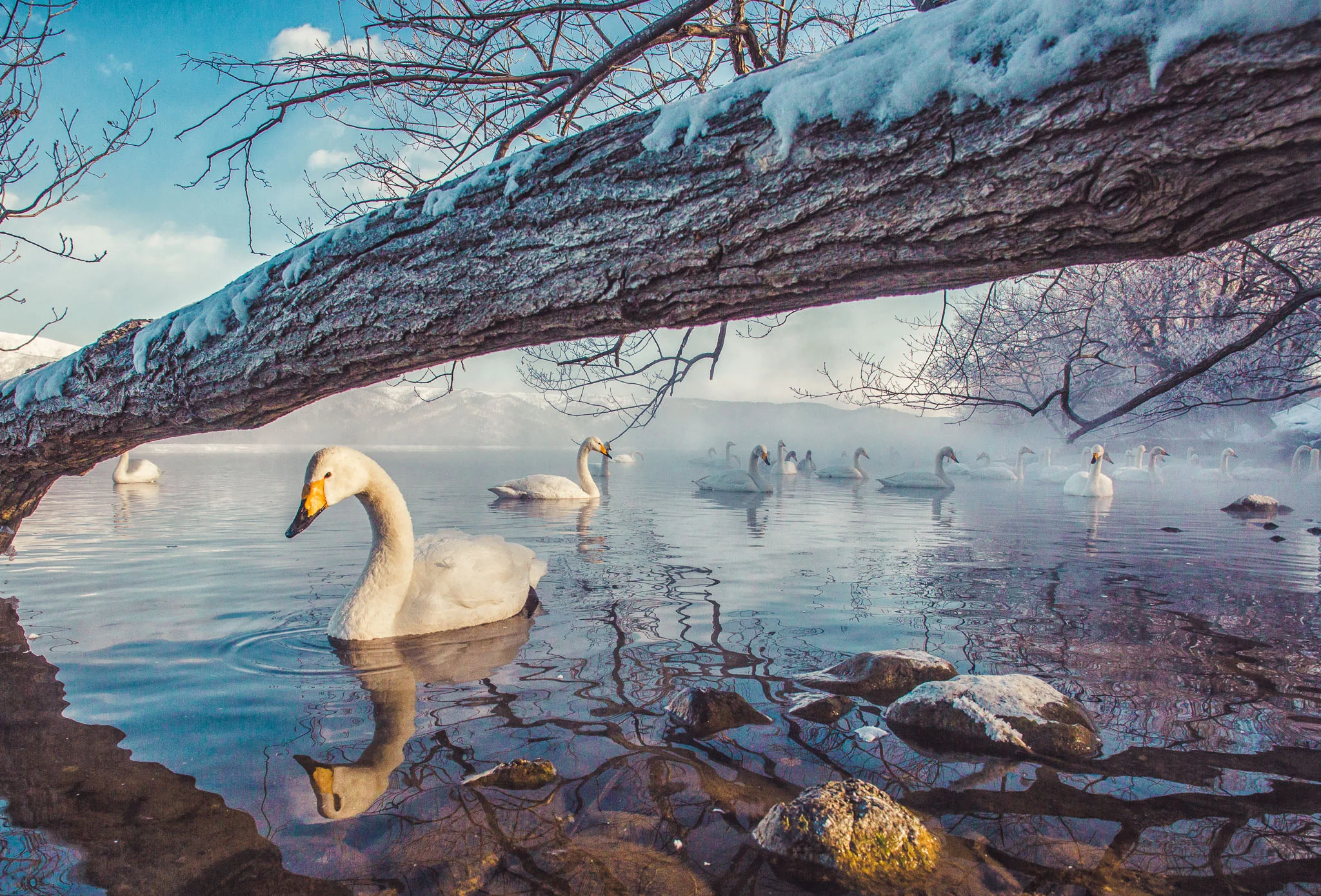
Whopper Swans
Be prepared for hundreds of keen photographers to be shoulder to shoulder with you and their tripods. Most will be set with an 800mm lens going trigger happy at 10 frames a second.

The cranes are in Tsurui-mura all year but most shooters love to combine the birds dancing in the snow during February.

Over the next two years however, feeding from the sanctuary will slow down to encourage the birds to be more self sufficient.

At Kusharo Lake we focused on Whooper Swans and Marsh Teet birds. A wide angle was used for most of the very friendly swans.
For the little birds a 400mm lens and a fast tracking focus mode worked wonders. Once again we were very lucky with the weather conditions, and the morning mist and fog created a dreamy atmosphere.
The iced lake and snow capped mountains were an added bonus.

For our last stop we ventured by car two hours north east to the coastal port of Rausu. Here we boarded a small cruise boat to search for sea Eagles to feed on the ice.
The Shiretoko Peninsula as seen on the long panorama shot below was stitched from 8 hand-held images.

Gear
For this trip I carried a minimalist kit - a Canon 5D Mark III, 100-400mm f4-f/5.6, and a Carl Zeiss 18mm Distagon lens. If you decide to travel at this time of year, be aware that extremely cold weather can affect your gear and you, and your feet and hands are the most important parts to protect to avoid frostbite.

Frozen Ice Patterns
For my clothing I had 3 layers for every part of my body. I bought rubber high boots with good grippy soles to avoid slipping on icy surfaces. You can also attach spikes to your boots if needed. Heat packs that last 24 hours can be purchased from most convenient stores.
They are called Hokkairo not Hokkaido. These are handy to keep your batteries warm if extremely cold. Keep your camera in your bag to keep it warm when you're not shooting.
Join Me In Hokkaido


7 Ways To Unlock Your Creativity
Let's be honest, regardless how creative you may be we all have our highs and lows. In the field of photography, creativity should be an essential part of why we started. Our passion needs to be unleashed. Here are some ways to help you unlock your creativity.

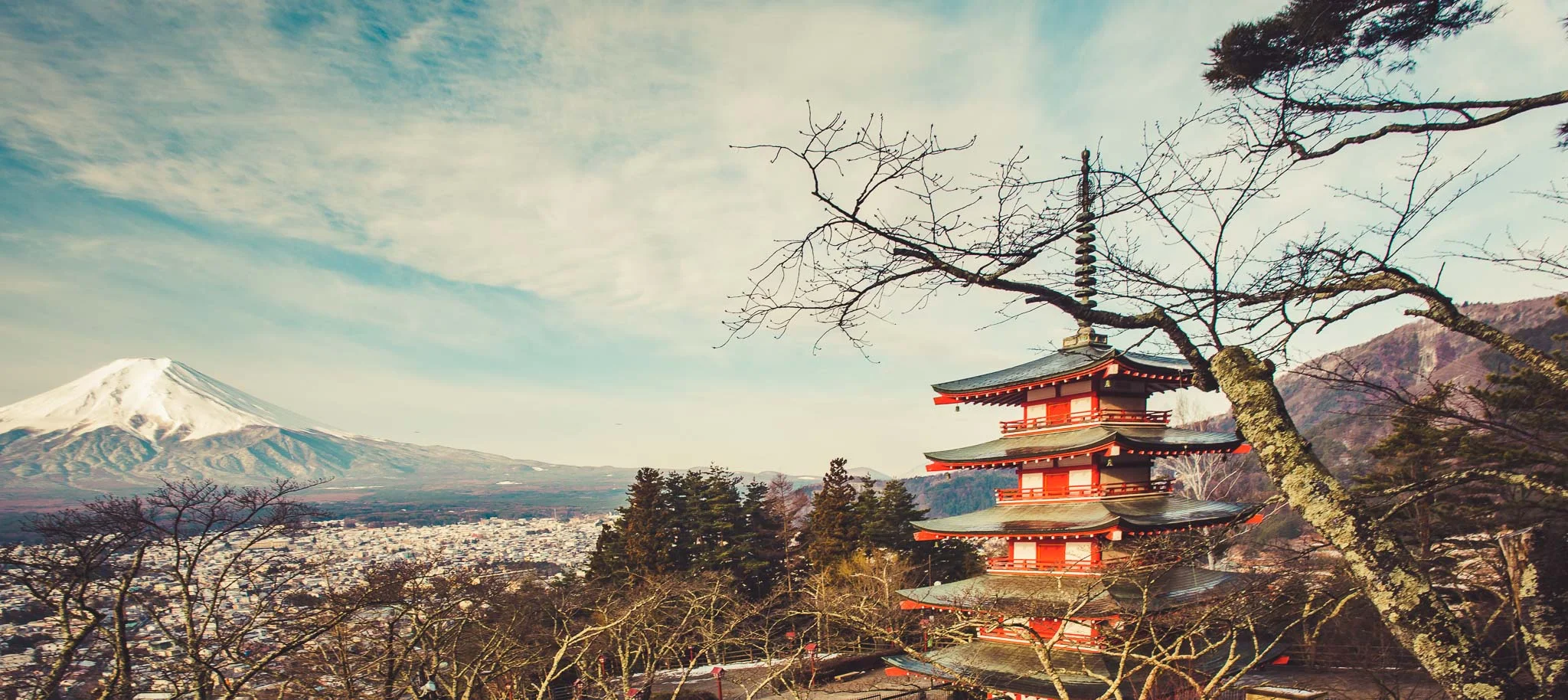
Mt. Fuji
Let's be honest, regardless how creative you may be we all have our highs and lows. In the field of photography, creativity should be an essential part of why we started. Our passion needs to be unleashed. Here are some ways to help you unlock your creativity.
Start a Project
Create regular projects for yourself until a series or cohesive body of work emerges. If you had to put together six to ten of your best images, what would they be about? Is there a narrative that you wish to express? What genre of photography are you looking to utilize? Keep a journal of your drawings or written ideas. I still have journals from years ago that I reference. The concept needs to be thought about properly. Merge your hobbies with your project. For example, I have combined my love of art, history, and culture. Why not try some new equipment or techniques for your project. You will choose between found pictures (e.g., photojournalism) and created pictures (e.g., conceptual). If you are lucky you might even be able to combine found with created pictures. Adding a composite of images in editing might lead to a series. A large part of the process is the wandering mind and experimenting.

Be Ready
Sometimes the best images are completely spontaneous. Half the skill is recognizing the special moments when they arise. Even if you don't see anything that particularly inspires you, try to get in the habit of shooting every day to improve your creative and technical skills. It takes hard work and discipline to get in the mood. Find out if you are more creative early in the morning or late at night. Set yourself some creative challenges to explore for certain elements and principles in composition (i.e., look for texture and repetition of shapes). Dreams, if you can remember them, are also a source of ideas. Salvador Dali, the surrealist painter, used to have an afternoon siesta with a paintbrush in his hand ready to paint.
Pre-Visualize
What do you have to do to turn your idea into reality? What are the challenges and how can you solve them? Collect reference material. I enjoy using Pinterest to create my own mood boards for possible projects. I love to explore different styles of painting and periods of art. For example, I enjoy dark and moody landscapes that have a melancholic feel. English Painter Sidney Richard Percy depicts what I am drawn to. Also, I often use three books to check on photography and art: "The Art Book" by Phaidon Press, "The 20th Century Art Book," and "The Photography Book." Even though some of you may not have an interest in art, you have to admire a painter's ability to capture light and master composition.

Change Your Perspective
I am glad I have not deleted some old photos to edit them again differently. Travel is a great way to stimulate your creativity. Visiting a new country, eating something bizarre, or learning a new language are all simple steps to re-wire new pathways. Experiencing a new culture and interacting with locals will surely give you a fresh perspective on life. In Claire Rosen's book "Imaginarium" she talks about divergent thinking and concepts that can come from a place, a person, an object, or an event to name a few. Be playful with your ideas and try not to think too literal. Comedian Robin Williams showed how this works best at 3:10 in this video.

Shoot Less, Shoot Better
Shoot without looking at the preview, this will force you to be in the moment. This will also force you to concentrate more on your idea and not on technical data. Also, try to imagine that each shot is precious. If you slow down and think about what you're doing, the number of images you shoot might go down, but the quality of your images will almost certainly go up. Turn off your preview mode while you are shooting a short 10-20 minute challenge. If you still have a film camera why not shoot a roll or two. Set yourself a timeline to work through this exercise to brainstorm ideas. When editing your best shots look at them once to avoid being indecisive and being too self-critical. Go with your gut feeling and intuition to make quick choice.

Trust
The only person you need to please is yourself. Don’t let anyone tell you how or what to shoot. Once you have an idea, follow it though to its conclusion. If there is someone else you trust and value their opinion, why not bounce your ideas off them? Collaborate with other artists who understand what you are trying to visually communicate. De-construct your ideas for time and budget. Sometimes I feel a need to gain more skills in Photoshop as a digital artist. Other times, I may need more experience lighting subjects to convey an emotion I am not achieving. The whole journey of discovery takes time, patience, and perseverance.

Understand Yourself
This seems like a logical step but it is one that is often overlooked. To get a basic understanding of psychology I often read from experts like Jeremy Dean who focuses many of his articles on creativity. Over the last 20 years of using photography as a medium of my self-expression, it has been very gratifying to tap into my past as a source of inspiration. I think of photography like a window to my subconscious memories. The end goal is to grow as a photographer and develop your skills and style to express yourself. Regardless of the outcomes, I always find it a very healthy experience. Have you got other ways to get you ready for creativity?

Tokyo's 5 Best Photo Locations
Tokyo is one of my favourite cities and I lived there for many years. While the crazy volume of traffic and crowds can be overwhelming at times, it's always an inspiring and surprising place to explore with a camera.
Tokyo is one of my favorite cities and I lived there for many years. While the crazy volume of traffic and crowds can be overwhelming at times, it's always an inspiring and surprising place to explore with a camera. So, where should you go if you only have a few days or less to shoot this incredible city? Here are a few of my favorite locations to visit with a camera, and the stories of some of the photos I have taken there.

Being a cityscape and street portrait photographer I am always looking for ways to best combine these two genres of travel photography. It goes without saying that Tsukiji fish market is also on the list but I have not included here. However, you can read about it in my previous article. I would suggest a minimum of three days to explore Tokyo.
1. Akihabara and Harajuku
In Akihabara (aka Akiba) is where you will find electronic shops, gamers, maid cafes, manga, and anime collectors. Stroll in just before sunset. Ask a few cosplay dressers for a quick street portrait or drop into a cafe to be entertained by the cartoon grins of a waitress dressed in a French maid outfit. At dusk set up your tripod on a busy intersection to mix street car light movements and neon-lit buildings. The area is riddled with photo opportunities that should keep you busy all night. In Harajuku it is best to visit on a Sunday afternoon. You will start to see many groups congregating around the train stations nearby. Simply walk up to them and ask permission for a portrait. Offer to email them a copy if they'd like.
2. Shibuya and Shinjuku
Shibuya Crossing is a bustling intersection in the center of Tokyo where seas of people cross from multiple directions every time the traffic lights turn red. Go at dusk and take your tripod or monopod to capture the movement of the crowds while keeping the streets, buildings, and neon lights in sharp focus. There are plenty of opportunities for street portraits of young and trendy couples in the surrounding streets; Look for well-lit areas and nice backgrounds. A shallow depth of field (f/2.8) with a 50mm lens will help to throw the background out of focus and create some consistency in your portraits. Alternatively, a wide-angle lens (16-24mm) will also work if you wish to capture the surrounding buildings. Walk across the infamous Shibuya crossing with your tripod or monopod and set it down in the middle of the road while crossing. Set your shutter speed to around 1-3 seconds and click. You only have about 30 seconds to cross so you only have one to two shots per crossing. Repeat the process at different angles to get different backgrounds.

Shibuya Crossing has to be Tokyo's busiest intersection.
Shinjuku, near Studio Alta at East Shinjuku train station exit, is a good spot to float around looking for shots of neon-lit streets and funky revelers. A tripod for the streetscapes will help you get tack-sharp shots at slower shutter speeds, down around 5–10 seconds, with car tail lights creating streaks in the image to add a dynamic feel to your pictures. Try and focus on back lights (red) more than front lights (white). Wait for large traffic flows and pick a corner that has curves to add a more dynamic look. There is a lane way near the station known as piss lane. Here you might find some great street portraits with permission. Be careful when photographing without permission as too many tourists have been invading this popular spot in the last few years. Having someone who speaks fluent Japanese with you will break the ice and you'll still manage some spontaneous portraits.
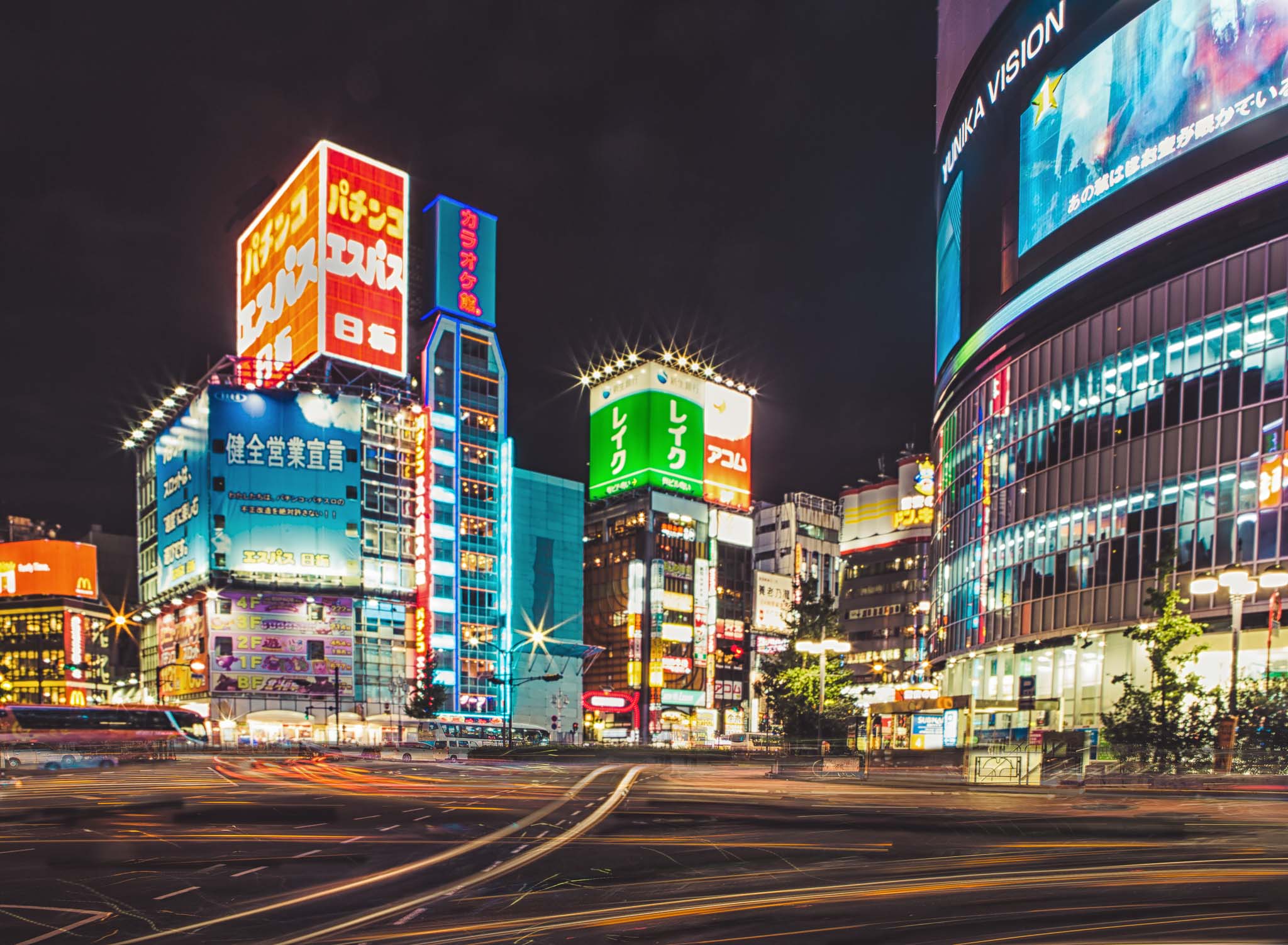
Near East Shinjuku subway exit.
3. Ueno
I used to live in the old downtown area of Tokyo, which is also known as Shitamachi, so there's a little bit of bias in this choice. This is also where my wife is from so I've spent plenty of time exploring the back streets and alleys with my camera. Nighttime in these areas is best explored on a weekday. Anywhere along a railway track close to a station you will find hole-in-the wall style bars and street stalls. Local businessmen flock to these cheap eateries for beer and light snacks.
Streetscapes are usually best shot from walkways looking down on traffic. Use your tripod and shoot with a slow shutter speed around 10–30 seconds to get some interesting trails of car lights. Neon lights also make for lovely backdrops. The high viewpoint will help to isolate and frame your shot better. Consider a black and white conversion.

Buddhist Monk in Ueno, Tokyo.
4. Ginza
The Ginza is another great spot for street portraits and modern architecture. Visit at the end of the day when the sun is low and the contrast between dark and light adds some drama to the scene. If you're looking for amazing modern buildings to use as backdrops or subjects of your photos, the following Ginza stores are worth typing into Google Maps: Hermes, Bulgari, Mikimoto, Dior, Gucci, Louis Vitton, Prada, Ferragamo, and Zara. Best of all, most are within a three or four-block radius of the Ginza Station.

Ginza's Wako Department Store is one of Tokyo's oldest.
5. Asakusa (Traditional Temple)
Asakusa is a district of Tokyo famous for the historic Sensō-ji Buddhist temple. The Kaminarimon Gate entrance to Asakusa Temple is usually crowded, but you can avoid the rush by visiting at night when the souvenir shops have closed and the tourists have gone home. If you do want to visit during the day, the best times to travel on the subway — and avoid being shoved onto a train carriage like a human sardine — are between 10 a.m. and 3 p.m. Another mini version of Asakusa is a place 45 minutes away by train called Shibamata also worth a look if you like this kind of ambience.

Asakusa at dusk.
Of course there are many more areas in Tokyo you can explore so I would recommend a look at the very comprehensive site of Japan Guide for more valuable and up-to-date information. Traveling around Tokyo to get the best shots will have a lot to do with the best time and day of the week.
Alfonso Calero – Travel Photographer from Sydney specialising in portraits and landscapes. Regular traveller with my small photo workshops/tours in Australia , Japan, The Philippines and Spain.